
Dugger Court Docket Searches
Open Indiana MyCase and pick Sullivan County rather than Dugger town. The Case tab fits a case, citation, or cross-reference number. Name searches a party. Attorney covers a lawyer or bar number. Broad results narrow quickly with the status and file-date fields. Once a match appears, open the Case Summary. Check the court, type, filed date, status, and newest CCS events before you draw any conclusion.
- Gather the exact name or identifier.
- Select Sullivan County in the Court field.
- Choose Criminal and Citation, Civil, Family, or Probate when useful.
- Open the matching result and check its court code.
- Ask the Clerk about missing documents, older records, or certification.
MyCase is a public access service, not the official record. Coverage and online documents vary. A missing icon does not mean no filing exists. An absent result can reflect restricted access or older converted data. Confirm key facts against the filed order or the Clerk-maintained record. Small gaps are common. Verify anything that matters.
Dugger Town Records Stay Separate
Dugger town records live apart from court records. Municipal water, sewage, ordinances, and council material belong to the town or another local administrative custodian. So do Coal Museum information and Coal Festival files. The county Cities page lists Municipal Water at (812) 648-2118. It lists sewage disposal at (812) 648-2173. Neither office keeps a CCS, court order, or judgment.
A Dugger police referral or ticket may lead to a county case. The source files stay distinct. Ask the town for a town record. Ask the Sullivan County Clerk for a filed Circuit or Superior Court record. That split keeps you from searching a government document index. It is not a court database.
Inside the Dugger Municipal Court
The Indiana Court Directory lists no current Sullivan Municipal Court. Superior Court handles all traffic infractions, misdemeanors, and small claims. Circuit Court handles juvenile, paternity, CHINS, probate, guardianship, adoption, and commitment matters. Local exceptions can apply. Felonies, many civil cases, protective orders, divorces, and legal separations may land in either court. The allocation plan governs that split.
Case numbers tell you which. A number starting 77C01 means Circuit. 77D01 means Superior. The year and month follow, then a case-type code and a six-digit sequence. Historical 77E01 numbers belong to the abolished County Court. The code locates the file; it never states the outcome.
Finding Dugger Court Dates
Check the newest CCS hearing entries first. Confirm any key date with the court itself. Sullivan does not appear on the live CourtCal participating-county list, so do not treat that service as the current local calendar. A continuance request alone is not proof a date moved. Only an order or a later event showing the result settles it.
| Date and time | The current setting recorded in the CCS. |
|---|---|
| Court | Sullivan Circuit or Superior, not a city court. |
| Reason | Arraignment, pretrial, trial, review, or another hearing type. |
| Result | A completed, reset, or canceled event when entered. |
A canceled hearing does not dismiss the case. Read the later entries and orders before assuming anything.
Dugger County-Court Record Hub
Sullivan is the county seat and the only city among the five ranked communities. Its courthouse at 100 Courthouse Square houses both Circuit and Superior Courts. The present building went up in 1928. The Clerk's Office sits in Room 304, and its published phone is (812) 268-4657. Listed hours run weekdays from 8:00 a.m. to 4:00 p.m. Verify them before travel. The official Clerk page gives the local contact route.
Mail requests can go to P.O. Box 370, Sullivan, IN 47882. State the court, case number, desired event or document, date range, and copy type. Skip needless private data. In person, be just as specific. Bring the case number if known. Name Circuit or Superior. Say whether you want the CCS, a filed order, a judgment, or something else.
Certification differs from an ordinary copy. Transcripts follow a separate route. The local rule names the court reporter as transcript custodian. A quick call can save a trip. An old fee, an unclear document name, or a record needing review before release can all derail it.
Dugger Rule 9 Access
Indiana Administrative Rule 9 covers public courthouse access during regular hours. It also addresses remote access principles, daily calendars, and requests for compiled court data. The rule helps separate a person checking one Dugger case from a bulk-data request handled by the Office of Judicial Administration.
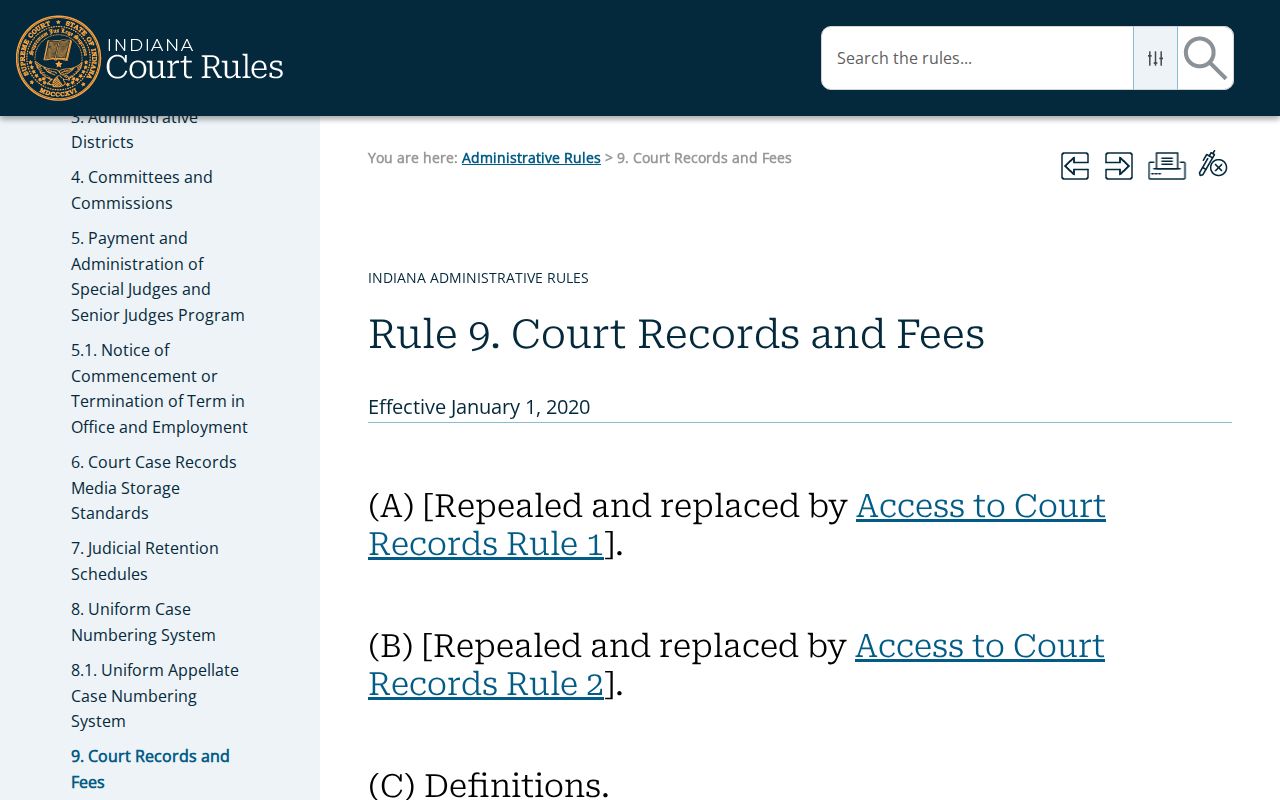
Courthouse access gets a boost from this rule, yet limits still apply. Rule 5 exclusions and standing court orders control what protected material the Sullivan County clerk can release.
Dugger Traffic Ticket Lookups
A Dugger ticket is filed in Superior Court, not a municipal court. Keep its UTT or citation number, leading zeroes included. Search the official Indiana ePay service for eligible tickets, or use MyCase by citation number. Not every ticket is online or payable there. A non-result should send you to the court named on the ticket and the Clerk. Do not assume the ticket vanished.
For the full payment, contest, and infraction-deferral route, see the county traffic court page. Confirm current balances with the Clerk, since online financial displays may lag.
Dugger Search Problems and Fixes
Dugger celebrates its Coal Museum and Coal Festival. Neither landmark adds a courtroom of its own. When a Dugger court record will not show up, work through the basics. Start with the identifier. Run the case number with punctuation, then without it. In a traffic search, though, keep the citation or UTT number exactly as written. Check spelling, name order, and the filing range too. Pick Sullivan County in the court field rather than searching statewide. A broad query can hit its result cap before it ever reaches the right person.
The paper that prompted your search deserves a second look. A utility notice, a council action, or a police incident number is not a case number. The county Document Center searches publications by title, department, category, topic, and year. It does not search by party or CCS event. Federal cases also stay out of MyCase. The Southern District of Indiana runs its own federal docket systems.
Still stuck? Call the Clerk. Ask whether the case predates online coverage. It may have been converted from an older system. It may have moved to the other current Sullivan court, or it may sit in a public document available only at the counter. Never ask staff to reveal a sealed or confidential record. The point is simply to find the right public file and its proper custodian.
How Dugger Cases Reach the County
A city agency can start a ticket or referral, but the filed case lands in the county system directly. No city-court step exists in between.
Docket flow: Dugger case origin › Sullivan County Clerk › Sullivan Circuit Court or Sullivan Superior Court
Federal matters go through the Terre Haute Division of the Southern District of Indiana and PACER, not MyCase. For state cases, the Sullivan County court docket offers the wider county route.
Dugger Court Record Fields
A Case Summary lists the case number, court, type, filing date, status, parties, attorneys, cross references, related cases, and dated CCS events. Those events run from filing and service to motion, order, hearing, judgment, payment, transfer, dismissal, and closure. A public document icon opens an attached filing. No icon does not mean the clerk lacks the document.
- Open
- The case remains active; check the latest event for the next step.
- Closed
- A disposition was entered, but the label alone does not state its terms.
- Canceled
- The marked hearing did not proceed as set; it is not automatically a dismissal.
- Converted event
- An older entry migrated from a prior case system.
Dugger Population Is Not Caseload
The Census Bureau's 2025 incorporated-place estimate put Dugger at 797 residents. That made it fourth-largest in the county's official top-five ranking. The figure describes the community. It is not a tally of cases, litigants, tickets, or hearings. A population row and an Indiana trial-court statistics table answer very different questions.
Rank changes nothing about the court route. Shelburn, Farmersburg, Dugger, Hymera, and the smaller towns all share the same county courts. The state directory lists no separate town dockets. Those cases are not counted that way. A Dugger resident's case still lands in Circuit or Superior by subject and allocation, never on a special city calendar.
Practical point: Use Dugger as a town-of-origin fact, but use Sullivan County as the MyCase court selector.
For caseload context, certified ICOR reports break down county trial-court activity by year and court. That is their proper role. They cannot replace the CCS when you need one case, one date, or one order.
Who Can See Dugger Court Records
Indiana Access to Court Records Rule 4 sets the general public-access framework. Rule 5 pulls confidential records and protected data out of view, including certain juvenile, mental-health, adoption, sealed, and expunged matters. Rule 6 allows a court-ordered exclusion. Even a public case can carry redactions or documents unavailable online.
Key rules:
Access Rule 4 states the general access rule.
Access Rule 5 identifies excluded records and information.
Access Rule 6 governs court-ordered exclusion requests.
Request a narrow record and confirm it with the custodian. City administrative files and county court files run on separate channels.